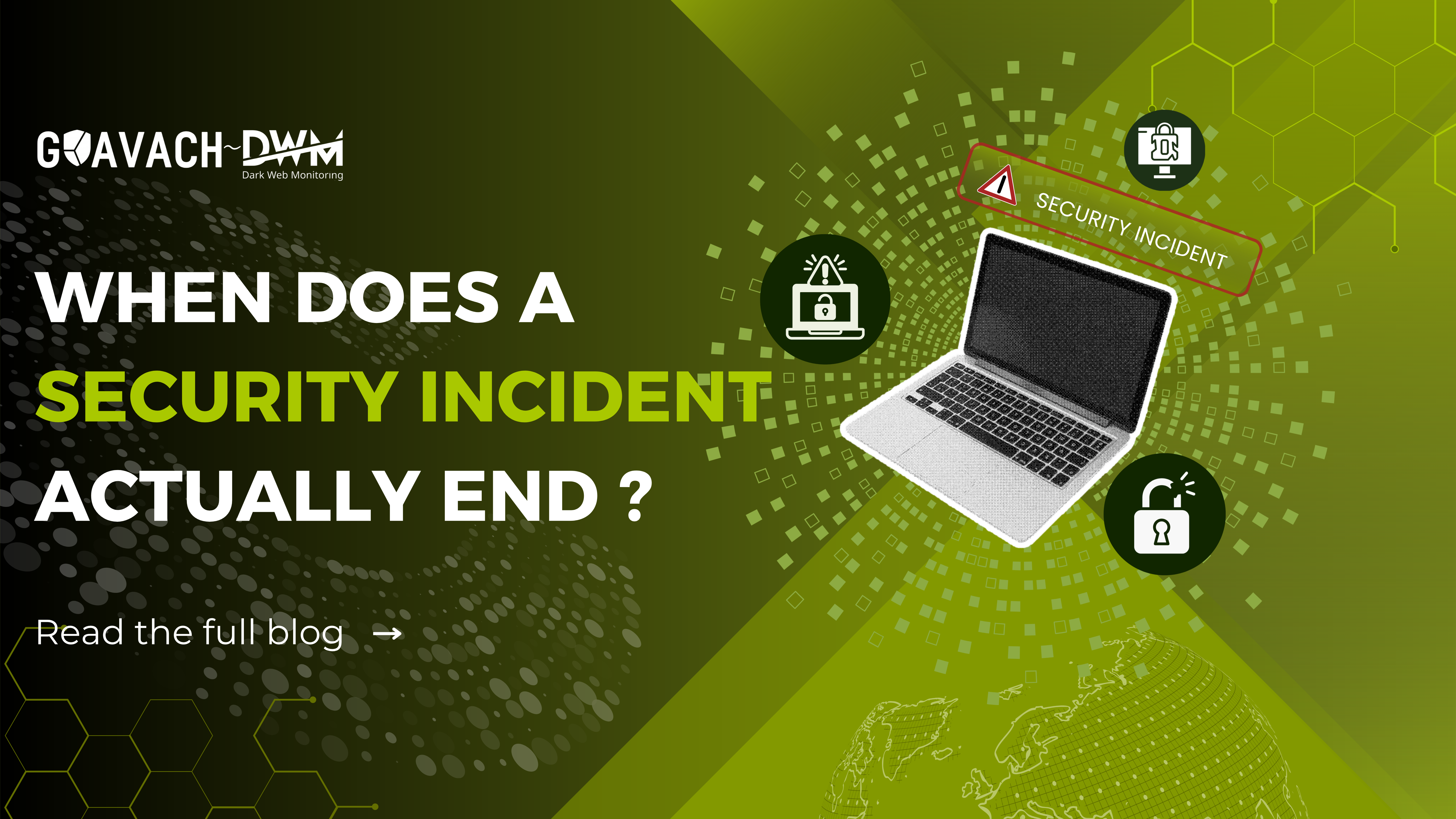
When Does a Security Incident Actually End?
Most organizations define the end of a security incident through operational milestones:
-
The malicious activity has stopped.
-
Affected systems have been isolated.
-
Credentials have been reset.
-
Recovery has been completed.
-
The incident report has been finalized.
From an incident response perspective, these milestones often signify success.
However, from an exposure perspective, the incident may be far from over.
Modern attacks increasingly focus on stealing data rather than simply gaining access. Once credentials, documents, customer records, or sensitive internal information leave an organization's control, they can continue circulating across criminal ecosystems for months—or even years.
The critical question is no longer whether the attacker has been removed.
It's what happens to the data after they're gone.
The Traditional Definition of Resolution
Historically, incident response has focused on four primary objectives:
-
Identifying the intrusion
-
Containing the threat
-
Eradicating malicious activity
-
Restoring normal operations
Once these goals were achieved, the incident was considered resolved.
This model was effective when attackers primarily sought persistence, disruption, or unauthorized access to systems.
Today's threat landscape is different.
Many attackers prioritize data exfiltration because stolen information can be monetized long after the initial compromise has ended.
Infrastructure can be restored.
Passwords can be changed.
Data that has already been copied cannot be retrieved.
What Happens After the Breach?
Organizations often view the breach itself as the primary event.
In reality, it is frequently the beginning of a much longer exposure lifecycle.
After an initial compromise, attackers often extract sensitive data before leaving the environment. What follows can be significantly harder to track. Stolen information may be shared among threat actors, sold through underground marketplaces, or incorporated into larger data collections. Exposed credentials are frequently validated and tested against additional services, while corporate information may be leveraged in phishing, fraud, or impersonation campaigns.
By the time the original incident is formally closed, the stolen data may already be generating entirely new risks.
The greatest long-term impact often emerges after the attacker has left the environment.
Why Exposure Persists
Credentials Continue to Circulate
Compromised credentials rarely remain with a single threat actor.
They are commonly:
-
Shared among criminal groups
-
Sold through underground marketplaces
-
Included in large credential collections
-
Used in credential stuffing and account takeover campaigns
As a result, credentials exposed during an incident may continue appearing in attacks months after containment has been completed.
Stolen Data Reaches New Audiences
Internal documents, employee records, customer information, and vendor data often spread far beyond the original attacker.
Once distributed, the information may be:
-
Resold multiple times
-
Combined with other leaked datasets
-
Used to support phishing campaigns
-
Leveraged in business email compromise (BEC) attacks
The original breach may be remediated, while the stolen data continues to generate risk elsewhere.
Brand Abuse Frequently Follows
Attackers often use breached information to increase the credibility of future attacks.
Common examples include:
-
Executive impersonation
-
Fraudulent domains
-
Fake authentication portals
-
Highly targeted phishing campaigns
In these cases, the original incident becomes a force multiplier for subsequent threats.
Conclusion
A security incident should not be measured solely by the point at which an attacker is removed from the environment.
It should also be measured by an organization's ability to understand and manage the risks associated with the information that was exposed.
Containment ends the intrusion.
It does not necessarily end the exposure.
As cyberattacks increasingly focus on data theft rather than system access, organizations need visibility that extends beyond the moment of compromise.
Because in modern cybersecurity, the breach may last days.
The exposure can last years.