
The hidden exposure threatening your enterprise: From forgotten assets to full-scale breaches
When organizations consider cybersecurity, they often focus on the moment an attack becomes visible. A ransomware alert may flash on a server. A customer database might be accessed by an unauthorized IP address. A phishing wave could hit employee inboxes. These events are loud, immediate, and impossible to ignore.
But here is the uncomfortable truth that modern security teams must face: the conditions that make these incidents possible usually exist weeks or even months before the attack itself.
Enterprise digital risk rarely begins with a brute-force breach of a hardened corporate firewall. Instead, it starts silently, outside your network perimeter, with tiny pieces of exposed data and unmanaged assets that accumulate over time. You cannot protect what you cannot see, and in 2026, what organizations aren't seeing has become the primary entry point for sophisticated cyberattacks.
The Growth of the Unseen Enterprise
The physical perimeter of the corporate office has entirely dissolved. Today, an organization’s digital footprint is scattered across public clouds, SaaS platforms, remote endpoints, and external supply chains. While this hyper-connectivity drives business velocity, it creates a massive, invisible attack surface.
This hidden ecosystem is driven by two parallel forces: Shadow IT and Digital Exposure.
Digital exposure isn't just about an active hack; it refers to any information, system, or corporate identity that is visible to unauthorized parties. When employees bypass IT procurement to use unauthorized scheduling apps, or when developers clone repositories to personal GitHub accounts to work over the weekend, they create unmanaged digital risk.
To traditional security monitoring tools like internal firewalls or Endpoint Detection and Response (EDR) agents, these assets are completely invisible. They exist entirely outside the corporate security perimeter, yet they carry massive corporate risk.
Why Attackers Prefer Exposure Over Exploitation
Popular media often portrays cyberattacks as highly technical operations involving elite hackers writing complex exploits in real-time. In reality, modern threat actors are pragmatic businessmen. They look for the path of least resistance, spending far more time gathering intelligence than actively breaking into systems.
Instead of trying to force their way through a hardened perimeter, attackers use automated scanning tools to map an organization's external footprint from the outside in. They are looking for specific, leveraged pieces of information:
-
Exposed Infrastructure: Forgotten staging servers or legacy marketing microsites still attached to corporate subdomains.
-
Credential Leaks: Plain-text passwords, corporate email addresses, and API keys harvested from breaches of third-party, unauthorized SaaS tools.
-
Brand Impersonation: Lookalike domains and fake web portals built to look exactly like your corporate brand to trick users.
Once an attacker collects these pieces of the puzzle, they don't need to "hack" their way in; they can simply log in using valid, leaked corporate credentials. To your internal defense systems, this looks like a perfectly legitimate login, allowing malicious actors to bypass initial defenses completely undetected.
The Anatomy of a Breach: From Forgotten Asset to Dark Web Exploitation
To understand how a single overlooked digital asset can lead to a full-scale breach, it is useful to trace the lifecycle of a modern attack. This progression moves through three tightly connected phases, where each stage inherits and amplifies the weaknesses exposed in the previous one, transforming forgotten infrastructure into exploitable credentials and eventually into an enterprise compromise.
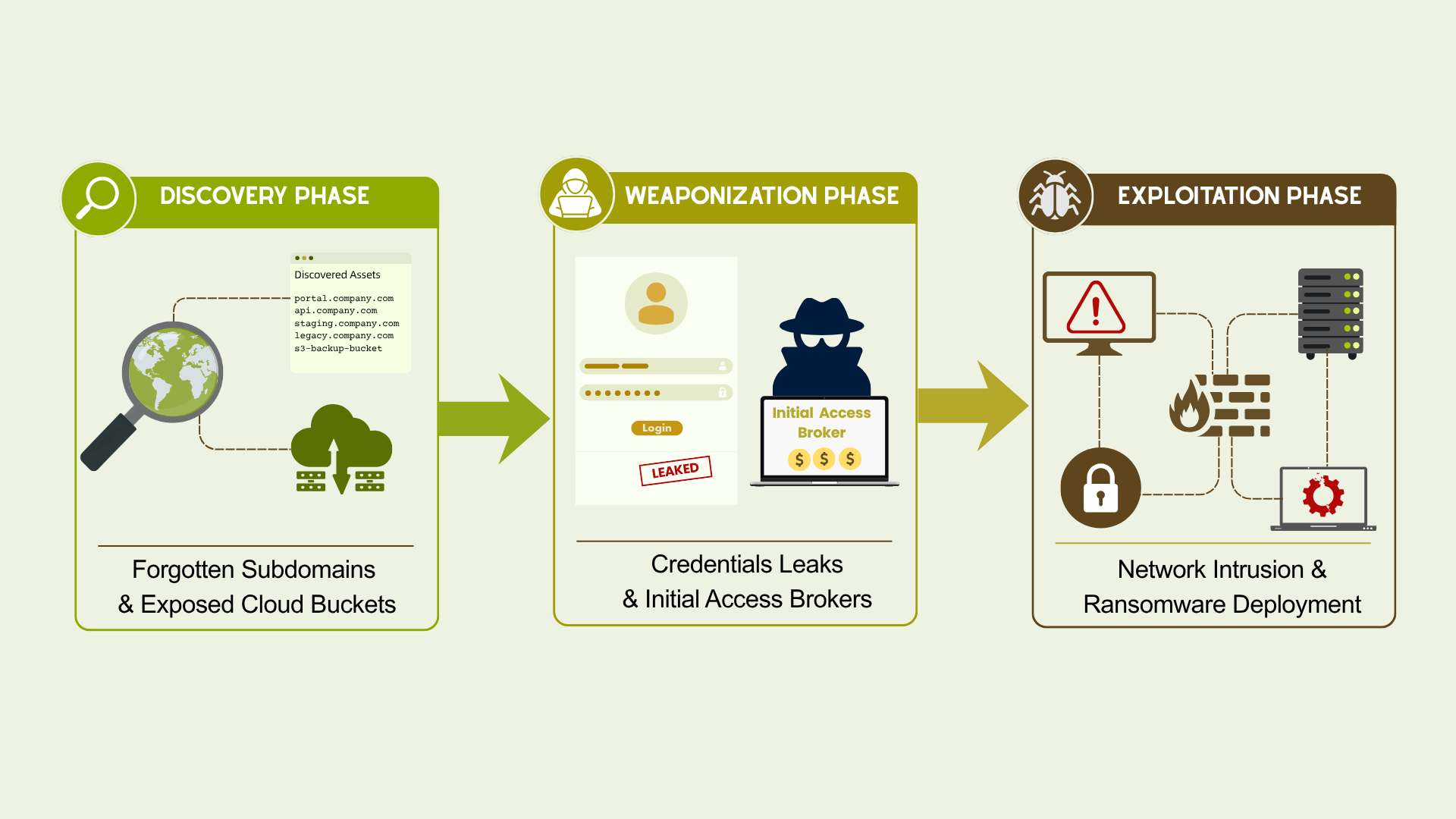
1. The Discovery Phase (The Forgotten Attack Surface)
It often begins with what appears to be harmless digital sprawl: a temporary marketing subdomain (e.g., rewards.company.com) spun up by an external agency for a short-lived campaign. Once the campaign ends, the application is abandoned, but never decommissioned. The DNS record remains active, the server continues running, and the underlying CMS quietly ages without patches or monitoring.
Critically, these forgotten assets are rarely isolated. They often still contain lingering digital artifacts such as:
-
Hardcoded API keys from third-party integrations
-
Session tokens tied to internal services
-
Misconfigured admin panels with weak authentication
-
Cached database credentials stored in configuration files
The asset is completely exposed to the internet yet essentially undetectable to security teams due to its absence from centralized inventory systems. As a result, a silent link between internal identification systems and the external attack surface is created, just waiting to be found.
2. The Weaponization Phase (From Exposure to Usable Credentials)
Threat actors constantly seek the internet for these overlooked systems. Exploitation starts with out-of-date CMS vulnerabilities or incorrectly configured services after the exposed subdomain is located.
The real turning point occurs when attackers uncover usable identity material inside the compromised environment, the same type of artifacts introduced in the Discovery Phase:
-
API keys granting access to cloud storage or internal services
-
Reusable employee credentials stored in legacy config files
-
OAuth tokens tied to SaaS platforms
-
Database connection strings with persistent authentication rights
These credentials are not just stolen, they are validated, enriched, and monetized. Automated systems test their validity across corporate login portals, while specialized threat actors, known as Initial Access Brokers, assess their value based on privilege level, domain reach, and organizational size.
Once verified, they are packaged into structured datasets and distributed through dark web marketplaces or encrypted messaging channels, transforming a forgotten subdomain into a commercial entry point into enterprise infrastructure.
3. The Exploitation Phase (From Entry Point to Enterprise Breach)
With validated credentials in hand, attackers shift from reconnaissance to execution. Automated tools launch credential-stuffing campaigns across VPNs, cloud dashboards, email systems, and SaaS applications, often successfully bypassing perimeter defenses because the credentials originate from legitimate internal systems.
From there, lateral movement becomes trivial:
-
Cloud environments are accessed using leaked API keys
-
Internal networks are mapped using privileged accounts
-
Sensitive databases are queried and exfiltrated in bulk
-
Persistence mechanisms are deployed for long-term access
By the time security teams detect anomalous behavior, attackers have already consolidated large-scale datasets, often including customer records, internal communications, and proprietary systems data.
What began as a forgotten subdomain has now evolved into a multi-stage identity compromise chain, resulting in regulatory penalties, reputational damage, and extensive remediation costs.
Closing the Visibility Gap with GKavach~DWM
The fundamental limitation of traditional security measures like firewalls and scheduled compliance audits is that they are designed to protect known infrastructure. They fail to capture real-time changes in an organization's external digital footprint, which can change drastically from one hour to the next.
Managing modern digital risk requires looking at your organization exactly the way an attacker does: from the outside in. This requires continuous, automated visibility across the entire internet, including the deep and dark web.
The GKavach~DWM platform is built specifically to bridge this visibility gap, providing enterprises with comprehensive external monitoring to neutralize hidden risks before they can be leveraged into a breach:
-
Continuous Attack Surface Mapping & DNS Intelligence: Automatically maps your organization's entire domain architecture, uncovering forgotten subdomains, open ports, and unauthorized cloud deployments to bring Shadow IT back under central control.
-
Proactive Brand Protection & Phishing Detection: Constantly checks domain registration databases for malicious brand impersonation and lookalike domains, enabling security teams to remove fraudulent infrastructure prior to an attack.
-
Automated Dark Web & Credential Leak Monitoring: Constantly scours underground marketplaces, hacker forums, and encrypted chat channels. The moment a corporate email, leaked credential pair, or sensitive document is detected, the platform issues an immediate alert so you can revoke access before threat actors pivot into your network.
Conclusion: Visibility is the Ultimate Defense
In an era where the enterprise boundary is entirely software-defined, perimeter defense is no longer sufficient. Modern cyber risks frequently originate outside organizational boundaries.
Digital exposure, exposed subdomains, and dark web leaks are the inevitable byproducts of rapid digital transformation. However, they only become catastrophic breaches when they remain invisible. Reducing enterprise risk is less about responding faster to an active attack and more about seeing the exposure earlier. By adopting an outside-in security posture that continuously monitors external exposure, enterprises can close the visibility gap and stay one step ahead of the modern threat landscape.